Your 12.5x21x4 slot is doing more for your family’s air than most homeowners realize. The 4-inch depth gives you room to run MERV 13 safely, something 1-inch filter owners usually can’t do without stressing their blower. Which MERV rating you actually pick, though, depends on who lives in your house and what they’re breathing. The real variables are pets, asthma, and that toddler’s room over the garage. Not the marketing labels.
We’ve manufactured this exact size in our American facilities for over ten years, and we stand behind every 12.5x21x4 air filter we ship. It’s one of the sizes where the MERV choice really matters, and where homeowners most often overspend on a rating their HVAC can’t actually support, or under-buy when they’ve got a pet and a kid with asthma. This guide is how we’d walk a neighbor through the decision.
TL;DR Quick Answers
Best MERV for most homes: MERV 11.
Best for allergies, asthma, or wildfire zones: MERV 13.
Best for odor control: MERV 13 with activated carbon.
Replacement interval: Every 6 to 12 months for a 12.5x21x4.
Biggest mistake to avoid: Skipping the replacement.
Your 12.5x21x4 advantage: The 4-inch depth lets you run higher MERV safely.
Pro tip: Buying pleated filters in bulk multipacks cuts cost-per-filter and protects you against running out mid-season.
Top Takeaways
The 4-inch depth is your real advantage. 12.5x21x4 air filters can run a higher MERV than a 1-inch filter without stressing your HVAC.
MERV 11 suits most households. MERV 13 is the right call for allergies, asthma, or wildfire regions. Add activated carbon if odors are a daily issue.
Replace every 6 to 12 months for a 4-inch filter. The same rule applies to anyone running whole-home filter slots on similar schedules. A loaded filter undermines any MERV rating you paid for.
Your blower is the limit. Verify airflow compatibility before jumping more than one MERV level.
A MERV 8 replaced on time beats a MERV 13 left too long. Auto-delivery removes the guesswork.
What MERV Actually Measures
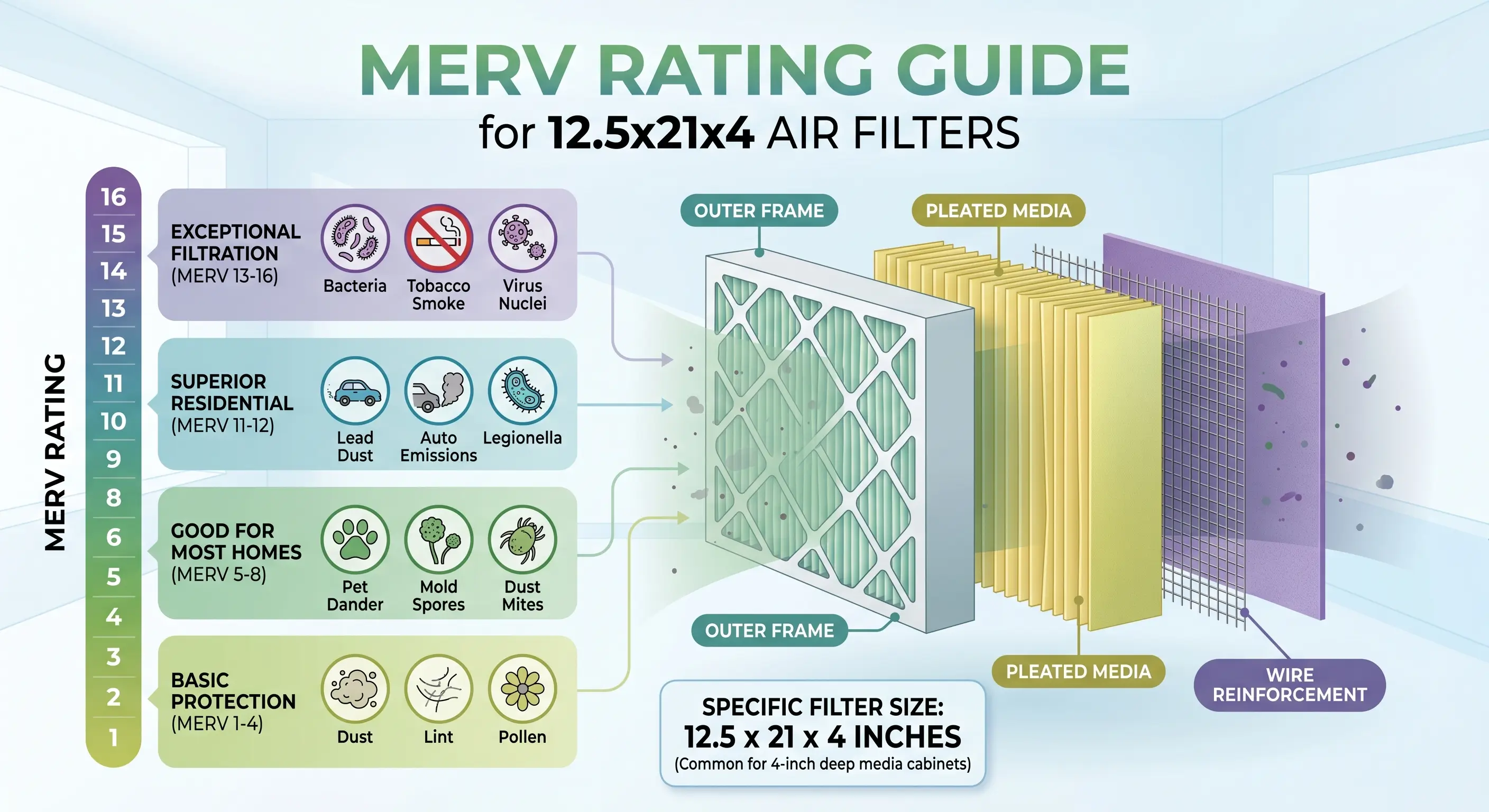
MERV stands for Minimum Efficiency Reporting Value. It’s a scale ASHRAE developed to grade how well an air filter captures particles between 0.3 and 10 microns. Higher number means smaller particles trapped. The residential range runs from MERV 1 to MERV 16, and if you want a deeper walkthrough of each level’s performance bands, this detailed MERV rating breakdown lays out the thresholds.
Why Size Matters for 12.5x21x4
A 4-inch deep media filter packs dramatically more pleated surface area than a 1-inch filter in the same slot face. More surface area means more particle capture without choking your airflow. That’s why manufacturers build central air conditioning systems with whole-home air cleaner cabinets around this depth. Your 12.5x21x4 can safely run MERV 11 or MERV 13 where a thinner filter might strain your blower. That advantage shows up most in allergy-sensitive homes that rely on four-inch filtration.
The Filterbuy MERV Lineup for 12.5x21x4
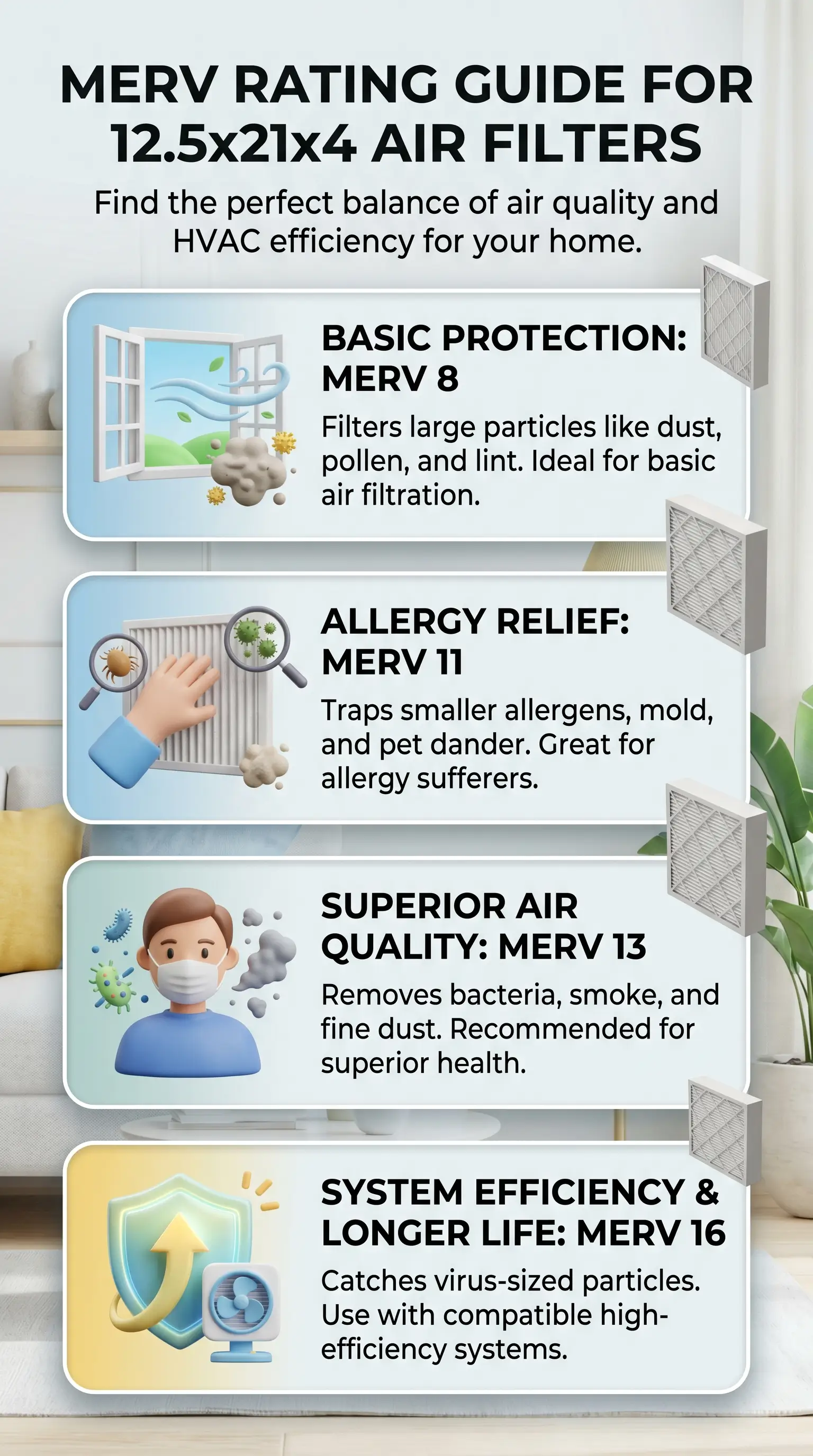
MERV 8. Traps dust, pollen, lint, and mold spores. Our baseline pick if you’re on a budget and don’t have pets, allergies, or asthma in the house. Basic MERV 8 multipacks work well for anyone who likes buying a season’s worth at once.
MERV 11. Adds pet dander, fine dust, and smoke particles to what MERV 8 already catches. This is our most popular pick with families who have pets or seasonal allergies.
MERV 13. Grabs bacteria, virus-carrying droplets, and wildfire smoke particles down to 0.3 microns. The EPA recommends MERV 13 as the floor for upgraded home filtration. We default to it for any home where asthma, severe allergies, or wildfire exposure is in play. If you want the clinical case for higher-MERV options in allergy and asthma households, the research has been piling up for years.
MERV 13 with activated carbon. Same MERV 13 particle capture, plus activated carbon for odor and VOC control. The pick if cooking smells, pet odors, or nearby traffic exposure are part of daily life.
How to Choose
Start with your household’s biggest air-quality challenge. Whether that’s pets, allergies, wildfire smoke, or basic dust control, it points you at the right MERV level. If you’re jumping more than one MERV from where you are today, watch the first month closely. Higher utility bills, longer cooling cycles, and warmer upstairs rooms all tell you the blower is working harder than it should. Comparing replacement filter options across common sizes can also help you see how 4-inch media stacks up against thinner alternatives.
Ten years of manufacturing this exact size has taught us something clear: the MERV rating matters, but replacement timing matters more. A clean MERV 8 will outperform a neglected MERV 13 every single time.
This isn’t just our opinion. Published breakdowns of how replacement timing varies by MERV rating show the same pattern we see in our own production data. The higher the rating, the more consistent the replacement schedule has to be to actually deliver what you paid for.
7 Essential Resources
If you want to dig further, these are the authoritative sources we point customers toward. Each one is from a different organization, and none of them sell filters.
EPA. What Is a MERV Rating? The federal explainer on how MERV ratings work and why particle size matters.
ASHRAE. Filtration and Disinfection FAQ. Guidance from the professional society that created Standard 52.2 and the MERV scale itself.
CDC. Taking Steps for Cleaner Air. Home-oriented advice on filtration, ventilation, and air changes for respiratory-illness prevention.
Wikipedia. Minimum Efficiency Reporting Value (MERV). The technical reference on ASHRAE Standard 52.2 and the full MERV scale.
U.S. DOE – PNNL. High-MERV Filters Guide. The specification guide HVAC designers and ENERGY STAR raters actually use.
American Lung Association. Clean Air Indoors. Health-focused guidance for homes with lung-vulnerable family members.
ENERGY STAR. Heat & Cool Efficiently. Federal program guidance on filter maintenance, HVAC efficiency, and replacement timing.
3 Statistics
Americans spend about 90% of their time indoors. Pollutant concentrations inside are often 2 to 5 times higher than outdoor levels. (U.S. EPA)
Indoor air can occasionally run 100 times more polluted than outdoor air. The people most at risk also spend more time indoors than average: children, older adults, and anyone with lung or heart disease. (American Lung Association)
ENERGY STAR–certified homes require a MERV 6 filter or higher. EPA Indoor airPLUS and DOE Zero Energy Ready Home programs require MERV 8 or higher. Your 12.5x21x4 MERV choice affects energy-program compliance, not just comfort. (PNNL Building America Solution Center)
Final Thoughts and Opinion
If we could hand every 12.5x21x4 customer one honest piece of advice, it would be this. Don’t default to the cheapest MERV. Don’t jump to MERV 13 because a forum told you to. Your filter is a system component. It has to match your HVAC, your household, and your replacement discipline.
For most homes running a 12.5x21x4 slot, MERV 11 is our pick. It’s a real upgrade over MERV 8 for pet dander, fine dust, and seasonal allergens, and nearly every modern residential HVAC handles it comfortably at this depth. Step up to MERV 13 if anyone has asthma, severe allergies, or lives through wildfire season. For cooking odors and pet smells, the activated carbon option earns its premium the moment you walk in the door. You’ll notice it.
One thing we’ll push back on. Higher MERV doesn’t automatically mean better. A clean MERV 8 will beat a neglected MERV 13 every single day. Replacement discipline is the filtration lever most homeowners underestimate.
Frequently Asked Questions
What is the best MERV rating for a 12.5x21x4 air filter?
MERV 11 works for most homes. It hits the best balance of particle capture and HVAC-friendly airflow. Step up to MERV 13 if allergies, asthma, or wildfire exposure are factors. Add activated carbon if cooking odors or multiple pets are part of daily life.
Can a 12.5x21x4 MERV 13 filter reduce my HVAC airflow?
In most modern residential HVAC systems, no. The 4-inch depth gives you enough pleated surface area to maintain airflow at MERV 13. Older systems or ones with borderline blower capacity should get a technician’s eye before you upgrade.
How often should I change a 12.5x21x4 filter?
Every 6 to 12 months is typical for a 4-inch filter, versus 1 to 3 months for a 1-inch. Pets, wildfire season, or an active construction project will shorten that window. Do a visual check every 60 days either way.
Is a 12.5x21x4 filter the same as a 21x12.5x4?
Yes. Manufacturers list dimensions in different orders, but the filter is the same. Always confirm the 4-inch depth matches your slot.
Does a higher MERV rating automatically mean cleaner air?
Only if your HVAC can handle the static pressure and you replace the filter on schedule. A clogged high-MERV filter actually restricts airflow and filters less effectively than a clean lower-MERV filter.
Ready to Protect Your Home’s Air?
Filterbuy manufactures 12.5x21x4 filters in MERV 8, MERV 11, MERV 13, and MERV 13 with activated carbon. Every one of them is American-made in our own facilities, ships fast, and can be set up on subscription so you never miss a replacement.
→ Shop 12.5x21x4 air filters
Protect what matters most: your family, your home, and your HVAC system.
Learn more about HVAC Care from one of our HVAC solutions branches…
Filterbuy HVAC Solutions - Miami FL - Air Conditioning Service
1300 S Miami Ave Apt 4806 Miami FL 33130
(305) 306-5027
https://maps.app.goo.gl/Ci1vrL596LhvXKU79